PERSPECTIVES | Graeme Macdonald reveals how JCB is faster than you think
SHARE:
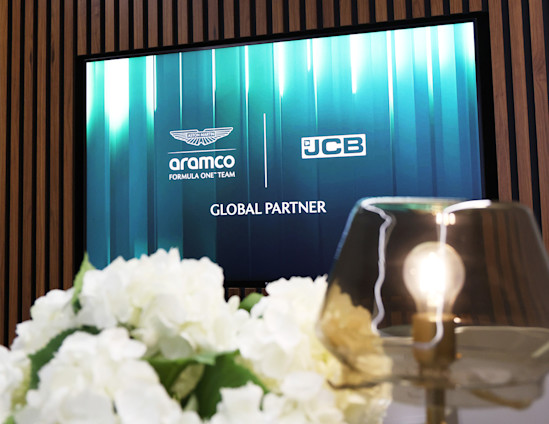
JCB has been a partner of our team since before we were Aston Martin Aramco. As the world-renowned British engineering brand celebrates its 80th anniversary and renews its long-standing partnership with the team, CEO Graeme Macdonald goes on the record about our journey together and where we're heading.
Founded in 1945, heavy equipment manufacturer JCB has the rare honour of being in the dictionary as the definition of a type of construction machine, and often, any large, yellow piece of earthmoving equipment seen at the side of the road tends to be referred to as a JCB. The business is based in Rocester, England, but has a global network of factories across 22 countries, employing over 19,000 people, supporting activity in construction, industry and agriculture in over 150 markets.
The business has instant brand recognition but operates in industries where the customer base is relatively small. It uses its partnership with Aston Martin Aramco Formula One Team to entertain clients, while simultaneously developing an ever-deepening technical partnership with us, covering everything from mechanical engineering to apprenticeship development.
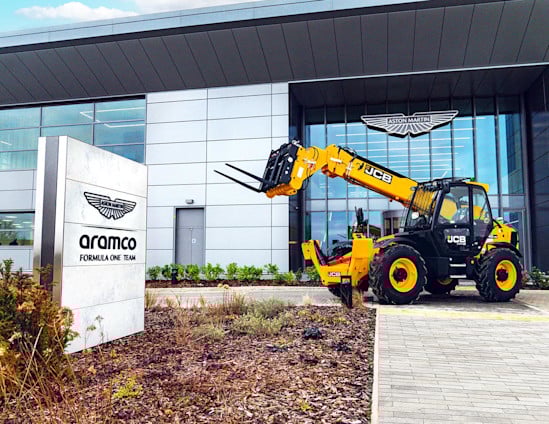
During a recent visit to the AMR Technology Campus, built, we might add, using JCB machinery, and with the ink still drying on a deal to renew our long-standing partnership, we found the perfect moment – about two hours before the Abu Dhabi Grand Prix – to put JCB CEO Graeme Macdonald on the record to explain why these two iconic British brands are such a good fit.
We're a private business, always looking at the long term
"JCB has just celebrated its 80th anniversary, which, not coincidentally, was also the 80th birthday of our chairman, Lord Bamford, born on the day the company was founded by his father. We're still privately-owned, which gives us more freedom to innovate. We can invest in new products and new technology and think about the long-term in ways that few other businesses can. Of course, short-term results are always important – but I don't have to answer to city analysts or worry about the share price... because there is no share price.
"A large proportion of our revenue is reinvested into R&D. Our business is very different to that of a car company. We have 350 current production models, ranging from machines weighing less than a tonne to those over 50 tonnes. In a typical year, we might launch 40 or 50 new models. We're not only involved in construction, we work in industry and have a growing presence in agriculture. Today, that accounts for more than 20 per cent of our business, and is a sector we want to grow.
"It's nice for us to be able to look back and celebrate our history, but our business is all about the future, much like it is at Aston Martin Aramco. We look at the next five years, the next 10… the next 80. For JCB, our customer bases are all very different – and meeting the needs of each requires us to commit to a pace of innovation that is absolutely relentless. Our products are very different to those in F1, but this commitment to innovation and development certainly has some similarities."
Many of our customers love F1, cars and racing in general, so being able to bring them into the sport offers a much sought-after experience.
Aston Martin Aramco helps us create deeper relationships
"Our partnership with Aston Martin Aramco provides us with the ability to deepen our customer relationships. We can host tours and dinners at the AMR Technology Campus, and we host guests at a number of Grands Prix each year. Our customers will typically come with their partners or children, and we get to spend more time with them over a Grand Prix weekend than would usually be the case and gain a better understanding of their business and their interests.
"It really is about the customer experience. We're not a consumer brand, so we're not all about advertising. Our customer base is actually quite small. The market for construction equipment is around only a million units a year, with some customers buying perhaps six or seven thousand units. We're highly targeted. Many of our customers love F1, cars and racing in general – a surprising number race themselves – so being able to bring them into the sport with Aston Martin Aramco offers a much sought-after experience. The hospitality offering is fantastic, but the big lure is, of course, meeting the drivers and getting to see the team at work in the garage.
"It's about deepening a relationship rather than creating one. We typically don't do this sort of thing with prospective customers, but rather with those who are already buying JCB equipment. I doubt it's ever a reason to place an order with us, but it is part of securing repeat business… certainly it makes it more difficult for them to order from someone else!"
Our business is absolutely about people. They are what drive us forward.
You might not think we're in the business of speed, but…
"I'd say we're not designed for speed – but we do hold the land speed record for a diesel engine vehicle, at 350.092mph, and have a 100mph backhoe loader and the world's fastest tractor. So, there has always been a real interest in speed, not just the physical kind.
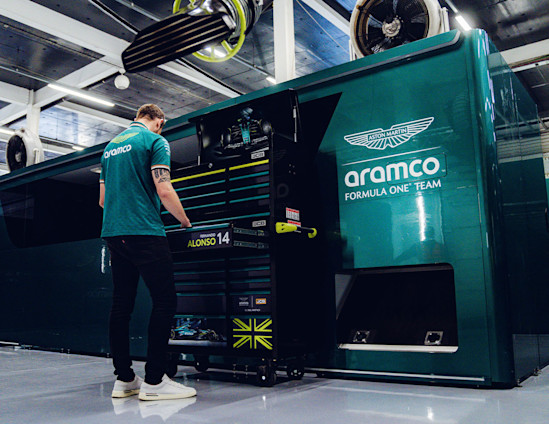
"We work with a sense of urgency, and it's an area in which we have learned a lot from Aston Martin Aramco, because an F1 team is always faced with a hard deadline. If something goes wrong during a race weekend, getting that fixed for the next session or next race is critical. The speed of engineering, of design, the use of rapid prototyping and bringing a part to production readiness, is something F1 does very well, and something we've been keen to observe. It's the speed of doing business. The speed of innovation.
"Of course, we're not working at quite the same pace, but the days are long gone of being able to wait six months for tooling before you can make a component. In the modern era, it's days or even minutes. Once a component is designed and signed off, you can have it within a few hours. Our ability to do this, and then test components or test machines, has evolved as we've learned from how Aston Martin Aramco works at the AMR Technology Campus. We're actually buying rapid prototyping machines from the AMR Technology Campus at the moment!"
The future is a combination of battery-electric, hydrogen, and even cleaner diesel. We're using less than half the amount of diesel in a machine than would have been the case a decade ago.
Bringing on young talent
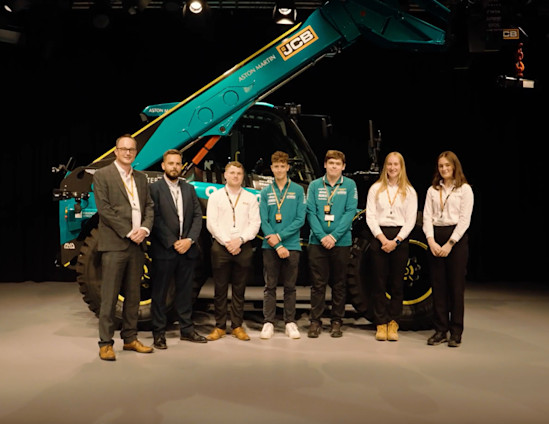
"Our partnership with Aston Martin Aramco is not just about technology, it's also about people. Our trainees and apprentices spend time with the team at the AMR Technology Campus, while junior members of the team come to us. There's an excellent spirit of collaboration within the young talent, and a lot of enthusiasm going both ways. It's fantastic for the future. We're both based in a part of England that inherently has a vast amount of engineering knowledge and talent, which perhaps doesn't get the credit it deserves – but the future looks very promising.
"Our business is absolutely about people. They are what drive us forward. Our ability to recruit the best and the brightest and retain staff for the long term is something that differentiates us from our competition. There is a commonality with Aston Martin Aramco in this. When there's a job opening at the AMR Technology Campus, the ratio of applicants to positions is huge. It's not dissimilar at JCB. It could be all too easy to take that for granted – but it's very important to take a step back and appreciate that we're attractive as an employer, and it's important to remain so.
"Ours is a business that prefers to promote from within. That becomes more complex as the organisation grows larger, but we can see the future leaders of the business coming through the graduate scheme now.
"Having them spend some time with Aston Martin Aramco is going to make them better engineers now and better leaders in the future. They're open-minded and like sponges for absorbing what is going on around them. When they bring that back to our business, that's fantastic."
We want to be known as the best, the most reliable, the most innovative.
Ours is not an automotive business...
"Our customers have a choice. Our competitors are good, well-run businesses that make good products. Relationships are a differentiator. Not in terms of providing hospitality – though that's not insignificant – but making the connection that lets them know our business will deliver the best customer support, have the best logistics operation and parts inventory. We're not the cheapest supplier in our marketplace and we don't want to be. We want to be known as the best, the most reliable, the most innovative.
"The bottom line is that our customers buy our equipment to make money. It's a business transaction and we have to make sure the total cost of owning a piece of equipment is the lowest. That might be stated in terms of highest residual value, lowest cost of repair, least downtime, best fuel efficiency.
"Of these, fuel efficiency is probably the area in which we share technology most closely with Aston Martin Aramco. At the moment, the cost of fuel is probably the most expensive factor in owning and operating a machine. It's also the biggest part of reducing our carbon footprint. The more fuel efficient we can make our machines, the less CO2 we emit as a business. F1's transition to hybrid technology, and now, to advanced sustainable fuels, is very interesting.
"We already have a range of pure battery electric machines – but it isn't a silver bullet. Indeed, I don't think there is a silver bullet. I think the future is going to see a combination of battery-electric for some applications, then hydrogen, and even cleaner diesel. We're typically using less than half the amount of diesel in a machine today than what would have been the case a decade ago, and there's more to come. Hydrogen is a very interesting technology, and we're investing heavily in it because it has a big part to play in the future of this industry.
"All these technologies will all be in the mix over the next 30 years, and the future is likely to be see hybridisation between them all – depending on the application. It doesn't necessarily follow that we would follow the same path as the automotive industry – because ours is not an automotive business. A consumer driving an electric car for 12,000 miles a year, at an average speed of 40mph, is only driving 300 hours a year. Our machines are typically running for between 2,000-3,000 hours a year, often day and night, often out in the fields, or a quarry far from charging infrastructure. Sometimes battery technology is not the best solution for that duty cycle – but hydrogen looks very promising."
We've been with Aston Martin Aramco every step of the way on its journey.
Every step of the way with Aston Martin Aramco
"We are very interested in how our partnership with Aston Martin Aramco can help us develop new technology, and provide better training for our people, and we're interested in how it can help us grow our relationships with customers… but we're also interested in the racing.
"Walking around the state-of-the-art AMR Technology Campus – which, I might add, was built using JCB machinery – the ambition is clear, and with the regulation changes for next season, it's going to be a completely new playing field for everyone. It's a really exciting time to be involved.
"It's not just about next season, however, this is about building for the future. We've been with Aston Martin Aramco every step of the way on its journey, and it's going to be very special to be stood alongside the team, as we have been for all these years, when it achieves its World Championship-winning ambition."
We use cookies on our website. By continuing to use this website you consent to the storing and accessing of cookies on your device in accordance with our Cookie Policy.
To learn more about cookies, how we use them on our site and how to change your settings please view our Cookie Policy.