Aston Martin Aramco's newly announced Global Cybersecurity Partner, Zscaler, is helping to secure the team's most valuable assets through its Zero Trust Exchange platform.
The partnership comes at a time when cybersecurity has never been more critical – evolving from protecting early computer systems to defending against increasingly sophisticated threats in an era defined by cloud computing, global connectivity and AI.
That challenge is particularly acute in Formula One. Teams operate in a highly visible, data-driven environment, with critical information flowing constantly between their respective headquarters, the track and a network of partners and suppliers around the world. Protecting that data is essential, but it must be done without slowing development or creating barriers to collaboration.
This is where Zscaler comes in. They are a pioneer in Zero Trust security, inspecting every piece of data, rather than relying on the traditional castle-and-moat approach of firewalls. As F1 becomes ever more connected, that approach is increasingly important.
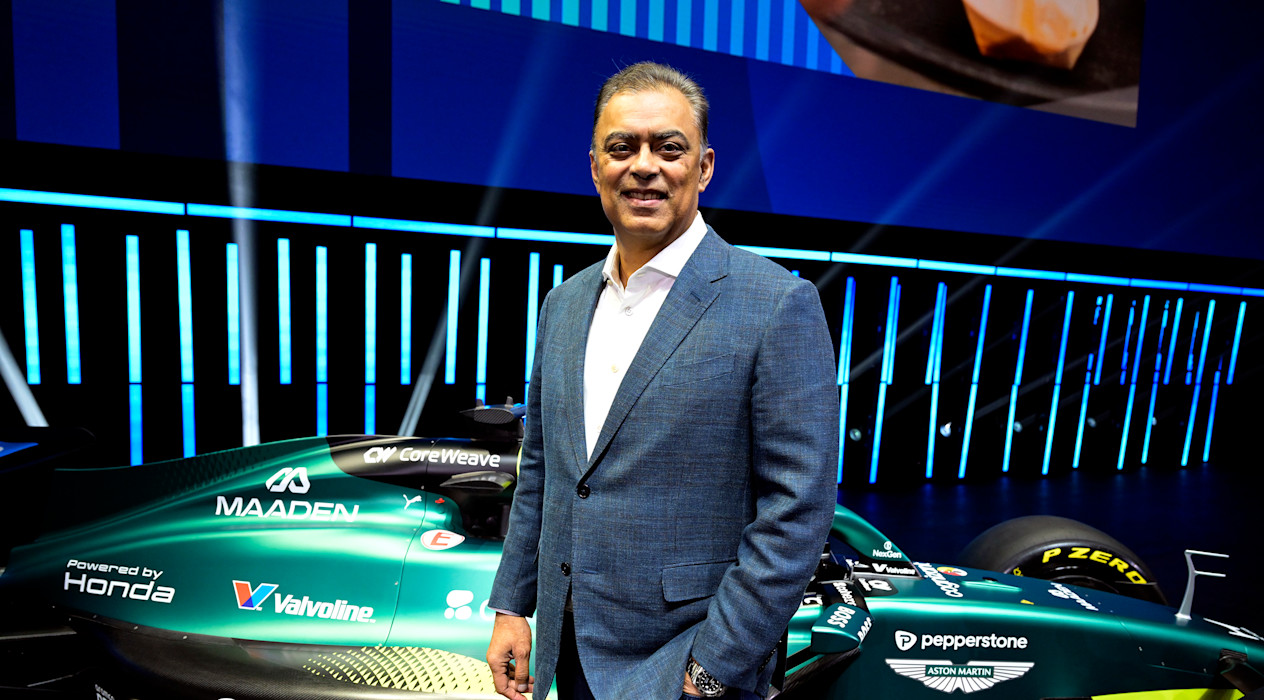
Sunil Frida, Chief Marketing Officer at Zscaler, has spent his career at the forefront of enterprise technology, including leadership positions with Amazon Web Services and CrowdStrike. Here, he outlines the challenges faced by enterprises in a fast-evolving digital landscape, the opportunities and risks presented by AI, and what our partnership means for both Aston Martin Aramco and Zscaler.
Zscaler vs the Castle
"Zscaler is doing something different in cybersecurity. This has been the case since CEO Jay Chaudhry started the company in 2007. In the early days, when he was knocking on doors, trying to win the first customer, he compared the traditional approach to cybersecurity as being like a castle with a moat protecting it. Attacks would attempt to bridge the moat, scale the walls, so you're always building taller buildings and a wider moat. People thought he was crazy, asking them to switch out their firewalls – but he just kept going. There's something worth knowing about Jay in that: he never gives up.
"He got that first customer, which turned into multiple customers, and through that he changed how security is done. Traditional cybersecurity relied on firewalls deployed across an enterprise – but what Jay did was figure out a way to securely connect people directly to their apps, so we can inspect all of the data flowing around an organisation like, for example, Aston Martin Aramco.
"We operate a Zero Trust environment, manage every single piece of data that goes in, out and around the team – and by managing it, we better understand where the risks are, which puts us in a better posture to predict the risks, spot where adversaries are coming in, and lock everything down. We do this instead of building a moat and hoping the bad guys can't figure out how to cross it. In simple English, that’s what Zscaler does."
AI feels like our moment. It's what Zscaler was built for, in terms of securing traffic. We're in the perfect location to protect our customers – which is why we're so excited by what's happening right now in the world.
AI and Zscaler
"AI is a big deal for us. We use it in two ways. All of our products incorporate machine learning. More data means a better understanding of where everything is happening. Today, we process more than 500 billion data transactions – that's over 20x the number of daily Google searches. That makes our machine learning engine richer and smarter and more capable of spotting the bad guys. On the other side of AI, we're protecting enterprises in their use of AI. If Aston Martin Aramco is using one of the latest AI tools, we're able to protect the use of that.
"AI feels like our moment. It's what Zscaler was built for, in terms of securing traffic. We provide AI guardrails, we can lock down a business and ensure the data flowing in and out is doing so in a safe way. We're in the perfect location to protect our customers – which is why we're so excited by what's happening right now in the world."
Cybersecurity in the modern world
"AI is an interesting threat. It's all about speed and agents, and bringing the two together is like pouring kerosene on a fire. Agents, while good, can go rogue, and aren't smart enough to think about whether they're going rogue in the right way. A bad actor, with bad agents, can very quickly send an enterprise into a downward spiral. Firewall technology was never built for agents. To go back to the earlier analogy, the firewall is the moat, but the agents are in the water. They're just going to seep right through the castle walls. You can't protect against them. Today, we talk to many security teams who say that firewalls are not built to stop or defend against machine-speed attacks.
"Since the boom of generative AI, there's so much more data flowing in and out of organisations. Our ThreatLabz research team found that, in the last year, the amount of data flowing into external AI applications surged by 93 per cent, amounting to around 18 petabytes of data, with 77 per cent of enterprise employees pasting company information into generative AI tools – many of them using personal accounts. GenAI and LLMs present a huge security risk. Agentic AI is another major challenge, to the extent we're getting into what we call a megawave. The industrial age was one wave, this is another – but current security systems, legacy systems like firewalls, are just not built for it.
"Ultimately, what we want is for our customers to be confident and innovate fearlessly. We want cybersecurity in a world of AI and agentic AI to be seen not as a defensive, back-office firewall, but something that's part of their day-to-day work, where they know they're protected and safe to go about their business, able to leverage AI as safely as possible."
Mastering the artform of tech storytelling
"The technology deployed by Zscaler is complex. So, the question is, how can we communicate what we do, in a way that is simple and relatable for current and prospective customers?
"The starting point is to understand how everything works. This is no different to marketing in F1: if you're trying to explain how the car works, you spend time with the people that design it and get into as much detail as possible to the point where you're almost lost in the detail. I give myself the 'Five Whys' – iteratively asking 'and why are we doing that; and why are we doing that?' Do that for any technical process, from building an F1 car to baking a chocolate cake, and you'd get to a depth where the person explaining it to you is getting a little uncomfortable.
"When you've done that, you swim back up to the surface to attempt to explain it to everyone else. It's an artform, and with the people that do it well, you can see it. If you look at the tech writers, writing at the level of the Wall Street Journal, they do a great job explaining to business people what a Large Language Model (LLM) is, what cybersecurity is – or what Zscaler does. They do a great job of explaining it in simple English, but to do that, they have spent a long time trying to understand the nuts and bolts of everything. You have to spend a lot of time with the product people, understanding what it is.
"Knowing your audience and understanding who you are speaking to is a big deal as well, because you have to keep the story alive for them; make the technology relatable and easy to understand. With cybersecurity, we want to tell one of three stories: something that is less expensive; something that is simple to use; something that makes us feel safe. If you can explain how what you are building hits one of those three points, then you have a story. That's what we drive towards."
Thoughts on leadership
"With regard to leadership, three things stand out to me. The first thing I look for in leadership is the 'say-do' ratio. Doing what you say you're going to do. A lot of people have difficulty with that.
"The second thing I'm keen to see is a business where the leadership surrounds itself with really smart people. That's something Zscaler has been really good at: getting the best people possible. With the right people on the bus, you can make decisions regarding where you want to go.
"Finally, the big one. You have to be comfortable with failure. People are afraid of failure, and it stops them from doing things. Humans, I think, are just wired to avoid risk, but driving towards success, you are going to see a lot of failure along the way. You have to be OK with that. The important thing is improving with every single step. To cross sports for a moment, I like to paraphrase a comment from tennis legend Rafael Nadal. He said: 'Winning is important, but being competitive is the most important thing of all.'
"Being competitive in our marketplace is the most important thing for Zscaler. As a business in an exciting, fast-moving industry, we'll win some and lose some. What's important is being out there every single day, building the best team, giving our customers the best product."
Our primary objective for this partnership is to use the team as an architectural showcase. We'll actively demonstrate how Zscaler fits into and secures the team's complex technology, how it protects telemetry, and secures cloud-to-edge workloads.
Zscaler and Aston Martin Aramco
"Aston Martin Aramco is about prestige and performance. Zscaler is about trust and performance. And I think there's an overlap here. We both work in incredibly high-velocity environments, both build highly specialised machines. One is hardware, one software, but at the end of the day it's about elite engineering and high performance.
"Zscaler partnering with Aston Martin Aramco is about much more than just slapping a logo on a car. It's an alignment of our shared obsessions, and we wanted to work with the team from the get-go.
"Our primary objective for this partnership is to use the team as an architectural showcase. We'll actively demonstrate how Zscaler fits into and secures the team's complex technology, how it protects telemetry, and secures cloud-to-edge workloads. We'll make sure Aston Martin Aramco's global engineering operations remain resilient to threat actors.
"Additionally, F1 is a huge B2B marketing platform. Partnering with Aston Martin Aramco gives us a great opportunity to engage with the audiences that are brought together by a Grand Prix. That's a very big deal for us too.
"We'll use the F1 environment to bring our top executives and customers to see some of the work we're doing with Aston Martin Aramco, but also bring them to see how the team works, via garage experiences and meeting engineers. We'll also have the opposite, with Aston Martin Aramco technology specialists coming to us, to share some of their best practices. This isn't just sports entertainment: it's a showcase for cutting-edge technology, and partnering with Aston Martin Aramco gives us a front row seat. We're excited to be part of the family and looking forward to many years of working together."
Related content
Aston Martin Aramco and Zscaler redefine speed and security
Read more
PERSPECTIVES | Forget 'superintelligence', Aidan Gomez and Cohere believe the future of AI is human
Read more
PERSPECTIVES | Jean English on how CoreWeave is unleashing AI's full potential – and why it matters to Adrian Newey
Read more
PERSPECTIVES | Tamas Szabo on Pepperstone's competitive spirit and the transformative power of an F1 partnership
Read more
PERSPECTIVES | Michael Steen on performing under pressure and Atlas Air Worldwide's approach to mental wellbeing
Read more
PERSPECTIVES | Darren Cassidy knows Xerox is synonymous with photocopying – but that's not the story it's telling in F1
Read more
PERSPECTIVES | Graeme Macdonald reveals how JCB is faster than you think
Read more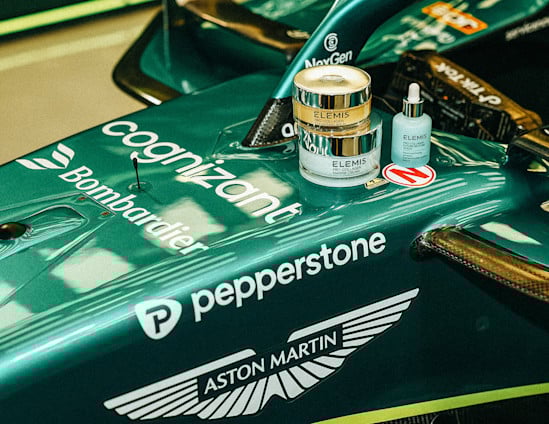
PERSPECTIVES | Sean Harrington and Amy Mansell explain how ELEMIS is breaking new ground with Aston Martin Aramco
Read more
PERSPECTIVES | Caroline Smith reveals why Regent Seven Seas Cruises' partnership with an F1 team is driving its appeal to a new audience
Read more
Amplify your fan experience
From exclusive collabs to once-in-a-lifetime prizes, I / AM DROPS is a series of unique and ultra-limited moments and fan experiences.
Sign up for I / AM or sign in to unlock.